
America has an interesting and tumultuous relationship with nationalism as a whole. In the 1940s, Nazi Germany was the main beacon of Nationalism. And America was against it. Now, we have an elected official talking about she’s a Christian Nationalist. But what exactly does that mean? And what does it have to do with Christofacism? And why should we give an ounce of attention to a nonsensical Congresswoman who believes in conspiracy theories? To understand America’s relationship with religion today, let’s look back at how the beginning religions have shaped America and the rise of Christian Nationalism – and in turn, Christofacism.
The Beginnings of Christianity was Prosecution:
Starting with one of the oldest religions, Christianity got its start in roughly the 1st century CE. The biblical version is sometime after Jesus of Nazareth died. And it came to head and was followed starting around 30-33 CE when Jesus was crucified.
There was the apostolic age (roughly when all the original Apostles were live) and the ante-Nicene age (roughly 100-325CE). The original Christians were a form of Jewish – following the sect of Second Temple Judaism.
During the Apostolic age, the teachings and church were very very closely related to Judaism and there was not too much of a difference in teachings.
The Ante-Nicene age is the time when Christianity really began to pick up steam, mostly in the 3rd Century CE. Third Century CE there was a lot of prosecution of Christians and Catholics during this time. Christianity was outlawed in most of the world and they were often persecuted and discriminated against – up until 380CE. This is when Constantine the Great of Constantinople, passed laws to make it illegal to discriminate against Christians. He also attributed his conquests to the Christian God.
Sometime between 1 CE and 380 CE, the number of people practicing Christianity rose by 40%. (Citation).

The above image shows the major branches off of the original teachings of the Christian Church – our discussion here will follow the major branches that eventually lead into Evangelicalism and further into Christian Nationalism and ChristoFacism.
The first major branch to cover is in the 11th Century. 1054: The East-West Schism. This is where The Christian Church split into the Roman Catholic Church and the Eastern Orthodoxy. The aforementioned infographic, it is called “Great Schism.”
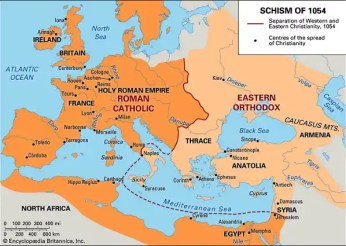
As seen above, it shows that the East-West Schism split the church. A majority of Christians were still presiding in the west ) possibly due to the fact that Eastern Orthodoxy encompassed the Middle East, where there were a lot of Muslims at this time. While the reason why the church split is debated, the two main reasons commonly cited are the legitimacy of the Pope and the celibacy of the priests (Roman Catholic priests could not marry while Eastern Orthodoxy priests could be married men).
It would be roughly 400 to 500 more years before the next large split in the Church. This time, the Catholic Church (the Western Church) would grow considerably more corrupt during this time. Evedrything was building up and came to a major head in 1517: when Martin Luther nailed the 95 These (AKA Disputation on the Power and Efficacy of Indulgences) to the All Saints’ Church in Wittenberg (along with mailing them yo tyhe Archbishop of Mainz).
An indulgence was also known as a permit. This was a “remission before God” and normally was a monetary value and a prayer – and originally it went towards charities like hospitals. These indulgences became corrupted through commercialization. This is where forgery would happen, excusing sinners from acts without properly donating. These forgeries would also extract the maximum time one used an indulgence for, to the point of excusing hundreds, even thousands, of years of sins for a person.
Martin Luther became so disgusted with the practice, that he created the 95 Theses. This document condemned the selling of Salvation to sinners and those in power who sold them. Luther did not speak out against the Pope, but rather against the corrupt preachers who used the idealogy of “As soon as a coin in the coffer rings, a soul from purgatory springs.” (A saying attributed to Johann Tetzel, attributed in Thesis 28).
It would not be until 3 January 1521 when Pope Leo X excommunicated Martin Luther. Several months later, Luther would be summoned to the Diet of Worms, where Holy Roman Emporer Charles V would brand him a heretic. He would be protected by various German Princes, but would ultimately pass in 1546 at the age of 62. Despite the tension between Rome and Luther, when Charles the V entered the town roughly a year later, he ordered his troops not to disturb Luther’s grave.
Luther Leads to the Reformation:
While Germany was up in arms about a heretic called Luther, across the English Channel, a man named Henry Tudor sat on the Throne of England – wanting a male heir, as was customary at this time. His nephew-in-law was Charles V, Holy Roman Emperor. Henry VIII was a devout Roman Catholic, much like his pious wife, Catherine of Aragon (daughter of the Spanish monarchs that lead the Spanish Inquisition of 1478, where they expelled Jews from the Iberian Peninsula). He had also received the title “Defender of the Faith” from Pope Leo X.
Some six years after the ex-communication of Luther, Henry has convinced his union with Catherine was “blighted in the eyes of God” as she was previously his brother’s widow – going against the scripture of Lev 20:01. Henry was denied an annulment several times and tried to get his wife – who had one daughter with him – to retire to a nunnery. Now, having a child is in direct contradiction to scripture, as Henry and Catherine would have to be childless for it to be cause for annulment.
After exhausting all options – at least in Henry’s mind – he decided there was only one way to deal with his pest divorce problem: Becoming the head of his Church.
The Church of England Leads to Bloody Civil War:
So come 1533, Henry VIII became the “Supreme Head of the Church of England” and had granted a divorce to Catherine, and was working on marrying Wife number 2 – Anne Boelyn. They would marry in secret some time in 1532 and have a second ceremony after discovering Anne was pregnant on 25 Jan 1533. Anne would “prematurely” deliver their daughter Elizabeth on 1 Jun 1533.
Unfortunately for Queen Anne, Elizabeth was a female. She could not inherit the throne. Thus, she and Henry would try again. In 1534 – after married life proved difficult for a head strong woman Henry. He was discussing ways to leave Anne without having to bring Catherine – who was exiled – back to court.
In 1536, Catherine dies. That would get around the having to bring Catherine back to court. In the same month, there was a tourney and Henry was unhorsed and injured – perhaps mortally. The stress of losing her husband would send Anne Boelyn into shock and a miscarriage would occur. The fetus was 15 weeks gestation… and male. The miscarriage of a male heir, and the fact Henry had taken a new Mistress – Jane Seymour – would be the final nail in the 28-Year-old Queen’s proverbial coffin.
In April and May of 1536, 5 men including the Queen’s brother George would be arrested for having “relations” with the Queen. While Anne was arrested on charges of “treasonous adultery” and incest. Henry had his marriage with Anne annulled, and she would be beheaded on 19 May 1536 at the Tower of London.
Henry would go on to have 4 more wives: Jane Seymour, who would bare him a son – Edward. She would day within 2 weeks. Meaning England needed a new Queen. Anne of Cleaves would be Wife #4. She was a political marriage and Henry would later have the marriage annulled because he did not find her “pretty enough” as her portrait. Anne would agree and it was mutual. She would live lavishly from then on. It was said she and Henry had a good relationship.
Wife #5 would be 17-year-old, Katherine Howard. Henry would be 49 years old at the time of his marriage to Katherine Howard. The two would be married a short two years before Katherine, now 19, would be beheaded for adultery with a man she would have had an affair with prior.
Catherine Parr would be the “survivor.” Catherine was known as a reformer through and through as well as the reason Henry reconciled with his daughters, putting them in the line of succession after his son and heir, Edward.
1547 would come and Henry would die. His son and heir, Edward, would ascend and become Edward VI. Due to him being 9 years old, he was not the age f majority, his reign was ruled via the council. His reign was sullied by economic unrest and social issues that resulted in riots and rebellion just 2 years into his reign. In Feb 1553, 15-year-old King Edward fell ill. He and his council would draw up “Devise for the Succession” once again writing his sisters out of the line of succession – naming his cousin Lady Jane Grey as his heir to keep the country from becoming Catholic again.
The council did not want a return to Catholicism due to Edward making Protestantism the main religion in England – abolishing the celibacy of priests and the Mass. He would popularize the delivery of using the vernacular in church services. It was Edward’s reign that would introduce practices used up to this day in Protestantism. The popularity of Protestanism would lead to issues faced by his sister Mary during her reign.
Unfortunately for Lady Jane Grey, Mary would depose her 9 days into her Queendom.
All Hail Bloody Mary: Murderess of Protestants
The first child of Henry VIII, Mary, would become Queen of England and Ireland in July 1553 until she died in 1558. In that short 5 year reign, she had re-established Roman Catholicism. To solidify this, she would marry her cousin Phillip of Spain, the son of Charles V – Holy Roman Emperor. They would co-rule together and Pope Paul IV would acknowledge their reign over Ireland together in 1555.
Mary began righting the wrongs done to her and Catherine of Aragon by her father. In her first Parliament, she declared her parents’ marriage valid and abolished laws set in motion by her brother before her. She restore the Catholic celibacy laws and denounced married priests.
Her Catholic husband convinced Parliament to repeal Henrey VIII’s religious laws and return them to Roman Jurisdiction. At this time, 800 Protestants fled into exile – those who remained were subject to hearsay laws. This is when the first of many executions began. She would go on to kill about 300 Protestants in her time as Queen.
Elizabeth Ascends – Protestantism Returns
Elizabeth would ascend after their sister. She would be the Queen who would patron the arts and die the Virgin Queen. She undid all the laws her sister put back into law. In 1570 – the pope at the time would name her illegitimate. Though she wanted England to be Protestant, she did not tolerate Puritanism as they were pushing for further reformation of the Church.
Virginia, United States, is named for the Virgin Queen. It would also be Queen Elizabeth would fund Sir Walter Raleigh establishing Roanoke Colony in 1585. When Raliegh returned in 1590 – Roanoke was no longer there. It was the first colony in North America for England.
Queen Elizabeth’s reign marked a Golden era in England, marked by poets and playwrights like William Shakespeare.
It Wasn’t Like the Disney Movie
1607 – Jamestown Colony is founded with the blessing of James I, the beginning of the Stuart line of English Monarchs. This would be the original permanent settlement of England. This is also where the Disney movie Pocahontas takes place. There were service run-ins with the indigenous people of the Powhatan tribe. John Smith would manage to reach an understanding that trade was necessary for the colonizers to survive. John smith would return to England in 1609, and that winter was known as “The Starving Time,” where some of the colonists would resort to cannibalism.
In 1613, Pocahontas, daughter of Chief Powhatan, would be captured during a skirmish. During this, she was “encouraged” (we can use the word forced) to convert to Christianity and baptized as “Rebecca.” She would end up marrying John Wolfe, a tobacco Planter, in 1614 and she would give birth to their son in 1626. At the time of their marriage, she was 17-18 and he was 29-30.
It was in 1616 that she would be taken to England where “Rebecca” was paraded around as a “civilized savage” so the Jamestown Colony could get investors. She would end up dying in England.
Thanksgiving Began with Religious Prosecution
In 1620, the Puritans landed at Plymouth Rock in what is today Massachusetts, Established Trade, and founded Thanksgiving. At least that is what is told to children in Elementary Schools.
The Puritans were persecuted ever since the Elizabethan era of England. This is because they were wanting to purge the Church of England of Roman Catholic practices. These Puritans were convinced the Church of England had not been fully reformed. They advocated the separation of all other Christian denominations, in favor of autonomous gathered churches.
The term “Puritan” was used to characterize a particular type of Protestant – an extremist. These Puritans were “more intensely protestant than their other protestant brethren or even the Church of England.” This term was not used by the Puritans themselves, as it was seen as abusive. They preferred to refer to themselves as “the Godly,” “saints,” “professors,” or “God’s Children.” This seems quite in line with idolatry.
The Puritans that sailed over from England were known as “separatists,” and decided England was not worth saving. This group was attributed to the founders of the Massachusetts Bay Colony. Some historians state that there were roughly 21,000 that moved across the Atlantic Ocean.
Now, this is not to say that these extremists were not illiterate, they believed heavily in teaching the bible. They were proponents of being able to read and interpret the bible themselves. As such, in 1635, they founded the Boston Latin school and then would go on to found “dame schools” for their daughters. This would result in Puritans being the most literate society in the world.
This would lead to there being 40 newspapers in the US by the time of the American Revolution some 100 years later in 1776. These educated parishioners would also go on to found one of America’s famous Ivy League colleges – Harvard.
Educated or Not – Prosecution Leads to Unjust Death
“The Devil is alive in Salem” (Hale, Act 2, Pg 68). The Crucible may have been written about 260 years after the events in Salem, Massachusetts, but it shows the hysteria of the Puritans there that thought they were battling the Devil among their parishioners.
Between February 1692 and May 1693, more than 200 people were accused of witchcraft. Thirty of them were found guilty, with 19 of them being executed by hanging. In one of the most famous cases, Giles Corey was pressed to death for refusing to plead and 5 others died in jail.
It wasn’t just adults that were accused, either. Teenage girls were often accused, but the age went as low as 4-5 years old with accused victim Dorothy Good.
As seen in times of political unrest and the decline of specific religions, the witch trials could have happened due to the sociopolitical unrest at the end of the 17th century.
Pre-Revolutionary America and The Great Awakening Begins
The 18th century saw the rise of Deism, the Great Awakening, and the unrest of the American Colonies.
The Great Awakening was a movement that began in the 1730s and was marked by the emergence of Anglo-American Evangelicalism. The preachers at this time “sought to include every person in conversion, regardless of gender, race, and status.“
This form of Evangelicalism took the Southern colonies by storm – and lead to the Baptist Missionary Society in 1792.
In the Next Part of this series on Christian Nationalism and Christo Fascism, we will discuss the First Awakening (The Great Awakening) in the US and how it would bring forth the evangelical ideal we see today in the US.
2 responses to “The Rise of Christian Nationalism: Lessons from History”
[…] The idiom used by Benjamin Franklin “…In this world, nothing can be said to be certain, except death and taxes.” is used very often in our society. Why doesn’t he mention student debt? Because it wasn’t an issue in colonial times. Education was more like a home-school situation than a government situation. Taking a look back at the post about the history of religion, we can recall Harvard was founded in the 1600s – but “formal education” was not very popular in … […]
[…] The idiom used by Benjamin Franklin “…In this world, nothing can be said to be certain, except death and taxes.” is used very often in our society. Why doesn’t he mention student debt? Because it wasn’t an issue in colonial times. Education was more like a home-school situation than a government situation. Taking a look back at the post about the history of religion, we can recall Harvard was founded in the 1600s – but “formal education” was not very popular in … […]